
Online double-conversion UPS
Continuously conditions power and delivers stable output to servers, storage, communications and critical controls, with no transfer time when switching to battery power.
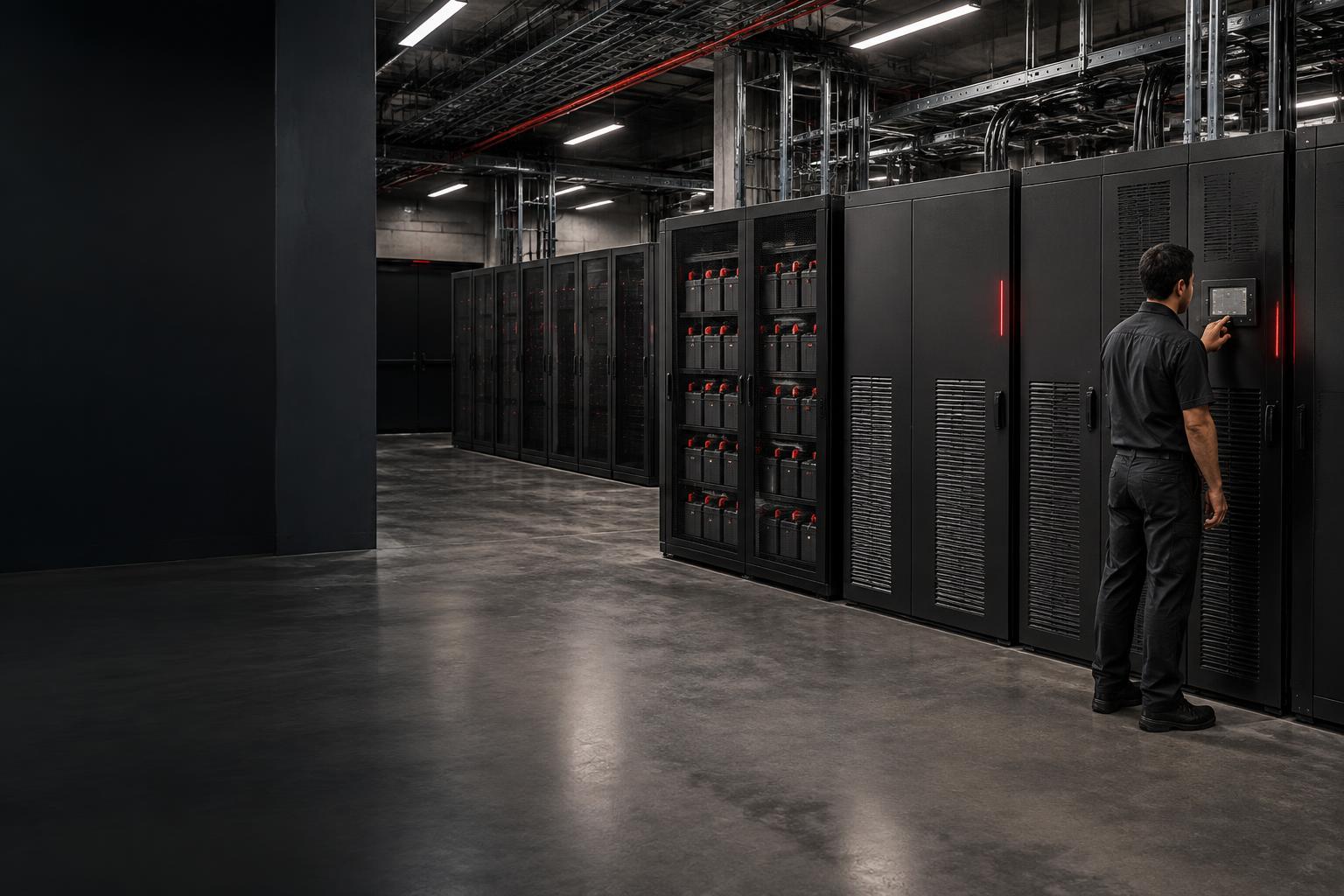
Critical power · Online UPS · SNMP monitoring · Mexico
We design UPS systems for servers, data centers and critical operations. We integrate double conversion, intelligent PDUs, batteries, bypass and monitoring to respond to power outages and fluctuations.
DIRECT ANSWER
A business UPS is an uninterruptible power supply that keeps critical equipment running during outages and conditions power during electrical fluctuations. For servers and data centers, an online double-conversion UPS provides stable output and monitoring, allowing time for a standby generator to start or a safe shutdown to take place.
A UPS does not replace a generator. It responds immediately and supports the load during the transition; the generator provides longer-term backup. Continuity depends on sizing both systems as a single architecture.
Every decision should reflect your infrastructure, required runtime and the level of continuity your operation needs.
Continuously conditions power and delivers stable output to servers, storage, communications and critical controls, with no transfer time when switching to battery power.
Distributes power within each rack, measures consumption and enables remote outlet control when required by the system design and operational permissions.
Integrates status, load, runtime, temperature, power events and battery condition with your NOC or business monitoring platform.
Determines runtime based on actual load, generator startup time and shutdown procedures, with suitable enclosures and protection.
Allows the UPS to be isolated for servicing when the electrical design and load criticality require continuity during scheduled maintenance.
Includes inspection, cleaning, functional testing and checks of batteries, connections and alarms, along with documented replacement recommendations.
BUSINESS APPLICATIONS
The load determines the architecture. A communications rack needs different protection from a complete room designed for growth and redundancy.
Protects sensitive loads from brief interruptions, fluctuations, electrical noise and outages while the agreed contingency plan takes effect.
Coordinates UPS systems, PDUs, battery banks, bypass, electrical panels and monitoring as part of a maintainable power architecture.
Provides backup power for switches, controllers, CCTV, access control and systems that must maintain a safe operating sequence during a power failure.
Standardizes protection, runtime and alerts for remote racks without relying on an on-site inspection after every event.
The best option is not the one with the highest capacity. It is the one that manages your load's risk and can be maintained without compromising operations.
| Criteria | Line-interactive | Online double conversion | Modular UPS |
|---|---|---|---|
| Recommended use | Non-critical workstations | Servers, networking and storage | Critical loads requiring greater resilience |
| Power conditioning | Basic voltage regulation | Continuous conversion and stable output | Continuous conversion with redundant modules |
| Transfer to battery power | A brief transfer time may occur | No transfer time for the load | No transfer time for the load |
| Maintenance | Individual unit servicing | Bypass according to design | Maintainable, scalable architecture |
The final selection requires a review of power quality, the electrical diagram, load, runtime, expansion plans and maintenance procedures.
BITS METHODOLOGY
A complete project establishes clear guidelines for operating, expanding and servicing the system after installation.
We inventory equipment, rated and actual consumption, expected growth, circuits, standby generators and site restrictions.
We specify power capacity, load factor, runtime, redundancy, battery banks, bypass and distribution without oversizing based on guesswork.
We coordinate electrical panels, protection, grounding, cabling, PDUs and commissioning according to the project and applicable requirements.
We validate alarms, transfer behavior, runtime and SNMP communication, and document the inventory, settings and preventive maintenance plan.
DELIVERABLES
Before recommending capacity or runtime, we document the variables that affect cost, risk and maintainability.
Backup power works best when designed alongside the infrastructure it needs to protect.
It depends on actual power demand, redundant power supplies, growth, runtime and criticality. An online double-conversion UPS is often considered for servers and telecommunications because it continuously supplies conditioned power with no transfer time when switching to battery power.
We assess the load in watts and VA, power factor, peaks, growth and required runtime. We also review the power supply, circuits, standby generator, temperature and redundancy. Choosing capacity solely by adding nameplate ratings can leave insufficient capacity or raise costs unnecessarily.
Runtime must match the continuity plan: support the load until the generator starts, sustain a specific process or allow an orderly shutdown. BITS calculates the runtime curve using actual load and expected battery condition rather than applying a fixed duration to every business.
A line-interactive UPS corrects certain fluctuations and switches to battery power when the input moves outside its operating range. An online double-conversion UPS continuously supplies the load through its inverter, providing greater isolation for servers, storage, networking and sensitive equipment.
An intelligent PDU distributes power within a rack and, depending on the model, measures consumption by phase or outlet, generates alerts and allows remote control. It helps identify available capacity, overloads and equipment that needs attention.
Yes, if the equipment has a compatible network card. You can monitor load, input, output, runtime, temperature, battery status and events, as well as send alerts or integrate the data with a monitoring platform.
Frequency depends on the manufacturer, environment, usage, discharge history and criticality. A preventive plan should cover batteries, connections, ventilation, alarms, capacitors and functional tests, with intervals adjusted to findings and equipment recommendations.
Schedule an assessment of load, runtime and site conditions. BITS will provide a technical recommendation to protect critical infrastructure without buying unnecessary capacity.
Business support in Mexico · +52 614 399 2945